July 24, 2026
Easiest All in One Winery Software for Small Wineries
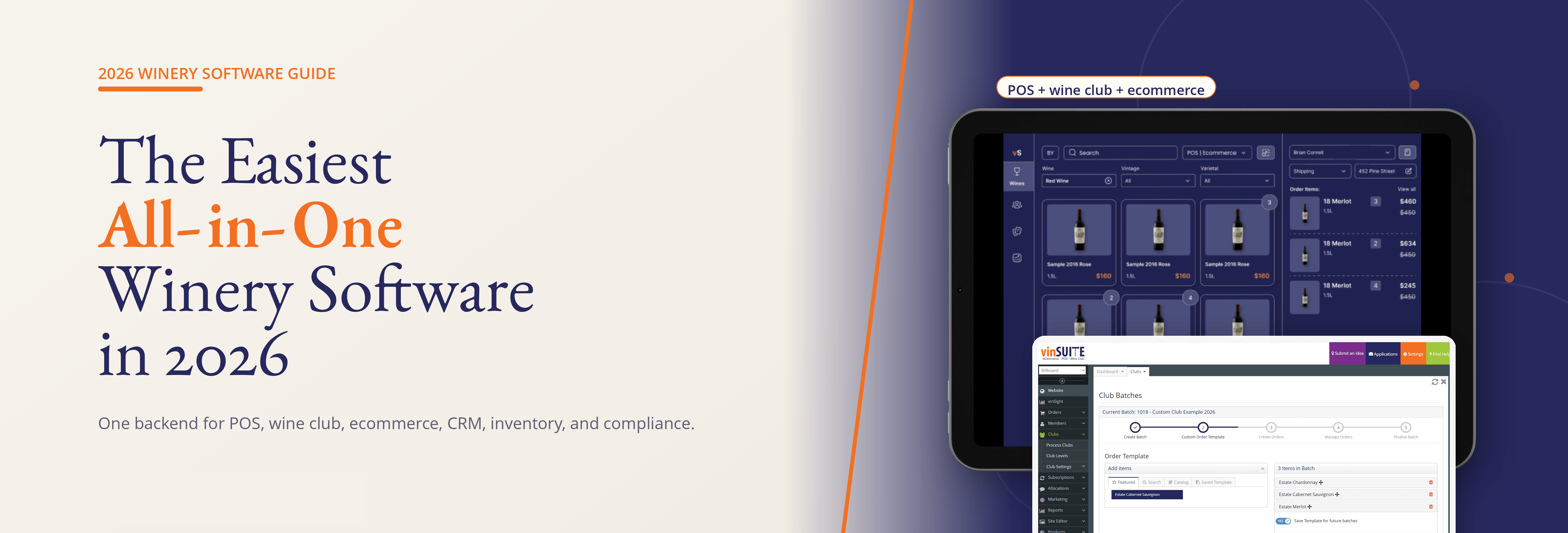
Running a small winery means wearing too many hats with too few hours. On any given day the winemaker is also the GM, the bookkeeper, the tasting room manager, the marketer, and the IT department. The last thing the team needs is software that adds another job to the list.
The market response over the last decade has been all in one winery software. POS, wine club, ecommerce, CRM, inventory, and compliance reporting in one platform instead of six. That promise has changed how small and mid sized wineries shop for software. But it has also created a new problem: most platforms that call themselves all in one are not actually easy to run.
This guide is for owner-operators, GMs, and DTC managers at small to mid sized U.S. wineries who want a clear way to evaluate winery management software in 2026, with the bias toward easy operation rather than feature checklists.
Quick answer: What is the easiest all in one winery software in 2026?
The easiest all in one winery software is a winery specific platform that connects tasting room POS, wine club management, ecommerce, CRM, inventory, and compliance reporting in one backend with one login and one support team. For small to mid sized U.S. wineries, vinSUITE is built around this premise, with TabletPOS sharing the same backend as the admin panel, ShipCompliant integration included, and unlimited human support after go-live.
What all in one winery software actually means
The phrase all in one gets used loosely. Before evaluating any platform, it helps to define what should be true if a vendor uses the term honestly.
A true all in one winery platform brings these capabilities together under one login and one admin panel:
- Tasting room POS
- Wine club management, including traditional, custom, allocation, and subscription clubs
- Ecommerce
- Customer relationship management with a single profile per customer across channels
- Inventory across multiple locations
- Compliance reporting and ShipCompliant integration
- Analytics and reporting, including predictive member behavior
- Payments
What all in one should not mean is a POS that integrates with a separate club platform that integrates with a separate ecommerce platform with a separate CRM. That is a stack, not an all in one. A stack can work, but it adds logins, support contacts, integration maintenance, and reconciliation steps that small winery teams do not have time to manage.
Why "easiest" matters more than "most capable" for small wineries
Most software buying guides rank platforms by feature count. For a small winery that is the wrong measure.
The reality at most small and mid sized wineries is a lean team. The owner-winemaker is in the cellar in the morning and pouring in the tasting room in the afternoon. The wine club manager is also handling member service, comp lists, and the next email send. The tasting room manager is training a new hire on a Friday for a busy Saturday. There is no IT department.
OND ramps do not pause for software training. Summer heat holds do not wait for IT tickets. A platform with 200 features and a steep learning curve costs more in staff time and frustration than a platform with the right 80 features your team can actually use on a club run weekend.
According to Silicon Valley Bank's 2024 DTC Wine Report, DTC sales account for roughly 72% of the average small winery's revenue. That means winery management software is not a back-office tool. It is the system running most of the business. The bar for ease is higher because the cost of friction is higher.
The easiest winery software wins because every hour your team spends fighting tools is an hour not spent serving guests, calling at-risk members, or building the next campaign.
7 signs winery software is actually easy to run
Feature lists do not tell you how easy a platform is to operate. These operational tests do.
1. One login gets you to everything
If your team needs separate logins for POS, club admin, ecommerce backend, and CRM, the platform is a stack with marketing copy. A true all in one winery platform has one admin login that opens every channel and every customer record.
2. The POS knows the member without staff gymnastics
When a member walks up to the counter on a Saturday, your staff should be able to search by name, email, or phone and see club tier, purchase history, pending pickup, and applicable discounts in one view. Discounts should apply automatically the moment the member is on the order. If staff have to look up a member in one system and apply the discount in another, the platform is not actually unified.
3. A new tasting room hire is productive on their first shift
Tasting room staff turnover is real. The platform your team uses every weekend should be trainable in a single shift. If onboarding a new pourer takes a week of side-by-side coaching, the POS interface is too complicated for the operational reality of a small winery.
4. Club runs do not require an export-import dance
A club run should generate orders, apply discounts, calculate shipping, hold for heat where required, and update inventory without exporting member lists, manipulating them in a spreadsheet, and re-importing them somewhere else. If your club manager builds a spreadsheet bridge between two platforms every quarter, the software is not all in one.
5. Inventory updates everywhere when one channel sells
A bottle sold in the tasting room should decrement the same inventory pool that ecommerce and club draw from, the moment the sale closes. If your team has to reconcile inventory across channels at the end of the night, the platform is fundamentally a stack.
6. The compliance integration is in the system, not bolted on
ShipCompliant is the compliance tool that comes up most often in winery sales conversations. The question is not whether a platform "integrates with ShipCompliant." The question is whether that integration is owned by the vendor, supported by the vendor, and works without your team troubleshooting the connection. Bolted-on integrations are the first thing to break during a club run.
7. Support picks up the phone and knows what a club run weekend feels like
Easy software is not just easy software. It is software with humans behind it who understand the operation. When a club manager calls on a Friday night with a payment issue 36 hours before a Monday shipment, the person picking up should know what is at stake. Generic SaaS support hours do not work for a business that runs hardest on Saturdays.
How vinSUITE approaches all in one for small to mid sized wineries
vinSUITE has spent more than 20 years building direct to consumer software for wineries. The platform is built around the way DTC actually runs: seasonal revenue, club run cycles, OND demand, summer heat holds, and the operational complexity that generic retail software does not account for.
The all in one design shows up in a few specific places.
One backend across POS, club, ecommerce, and CRM
TabletPOS runs on the same backend as the vinSUITE admin panel. There is no integration to maintain between the tasting room and the rest of the platform. When a staff member searches a member at the counter, their club status, purchase history, and pending pickup pull up instantly. Club discounts apply automatically. A pickup completes in the same transaction as a tasting room sale, and everything updates across the system at once.
One wine club product that handles every model
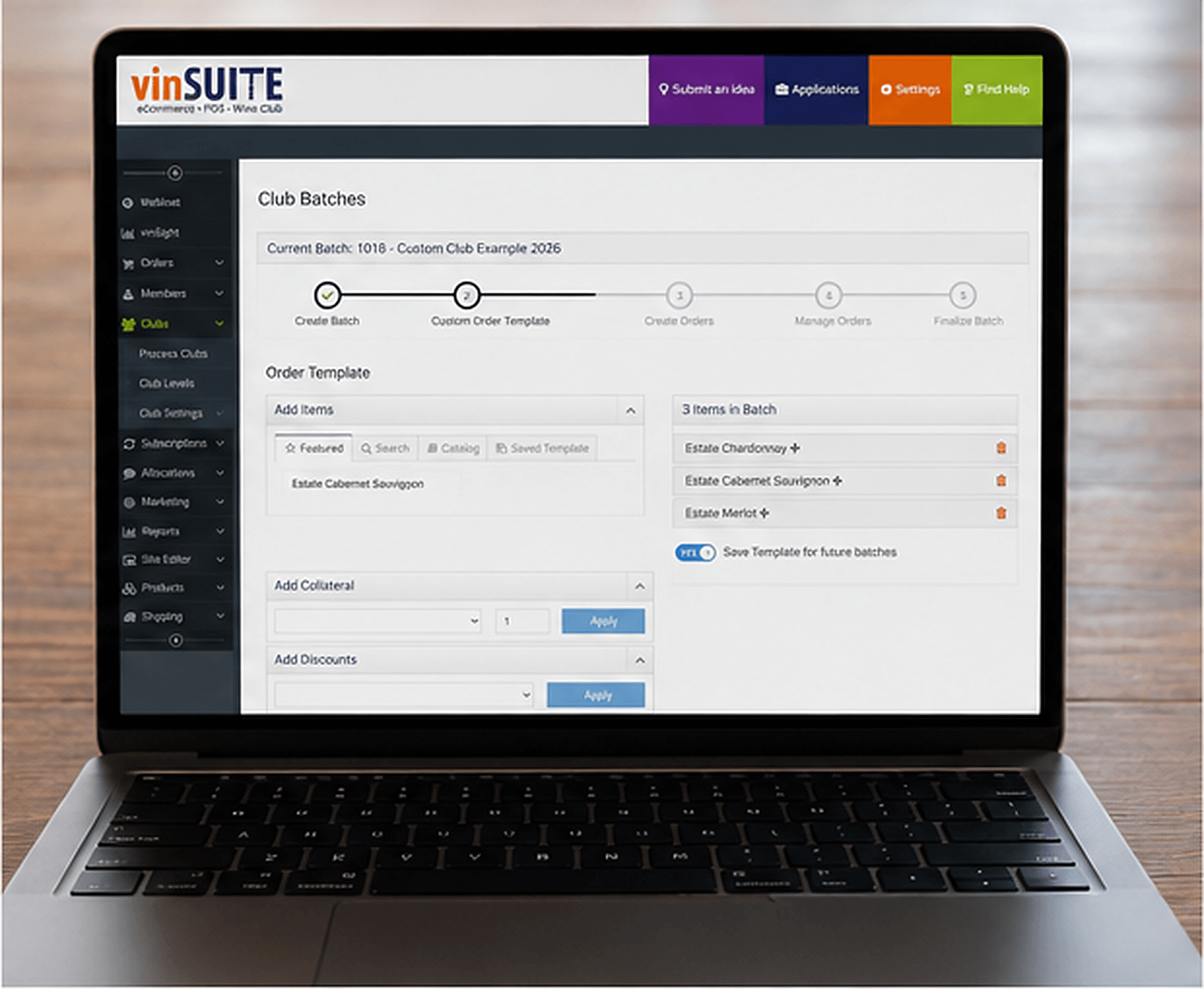
vinSUITE supports traditional clubs, custom clubs where members choose their wines, allocations, and subscriptions in one product. A single order status toggle lets the team manage a bulk run, continuous fulfillment, or high-touch member calling without rebuilding the workflow each quarter.
Built in analytics, including predictive churn
vinSIGHT is vinSUITE's built in analytics layer. It includes sales and club dashboards plus predictive churn scoring that identifies at-risk members with up to 94% confidence. Instead of finding out a member canceled after the fact, your team sees who needs attention before they leave.
Processor-agnostic payments
vinSUITE is processor-agnostic. Wineries negotiate their own rates with the payment processor of their choice instead of being locked into a bundled markup. For small wineries, this can be the difference between a sustainable margin on club shipments and a margin quietly eroded by a fixed processing rate.
ShipCompliant integration owned and supported by vinSUITE
ShipCompliant integration is included and supported by vinSUITE. It is the compliance integration that comes up most often in conversations with wineries, and it is in the system, not bolted on.
White-glove implementation around your club calendar
Implementation is planned around your club run schedule so you are not learning a new system mid release. The team handles data migration, team training, and a structured launch plan instead of handing over a generic onboarding checklist.
Unlimited human support
After go-live, support is unlimited and included. The people answering the phone understand what a busy Saturday on the floor looks like, what a club run weekend feels like, and what an OND ramp requires.
What to ask on a demo to test for "easy"
Demos are usually scripted around features. To test for ease, ask the vendor to show you these instead:
- Can my new hire run their first tasting room transaction in their first shift? Show me the lookup, the sale, and the discount application without switching screens.
- How many logins does my team manage in a normal day?
- Where does club, POS, ecommerce, and CRM data actually live? Is it the same database, or is the platform built from connected pieces?
- Walk me through a real club run end to end, including a heat hold and a failed payment.
- Show me a pickup completed in the same transaction as a tasting room sale.
- What happens when I call support on a Saturday at 2pm during a club pickup weekend?
- Who owns the ShipCompliant integration, and what happens if it breaks during a run?
- Can I see a current customer at a winery similar in size to mine and talk to them?
If the vendor cannot walk through these on a live screen, the platform is probably not as unified or as easy as the marketing claims.
Conclusion
For a small winery, the easiest all in one winery software is the one that fits the operational reality of a lean team. One login. One admin panel. One source of truth for customers and inventory. One support team that picks up the phone and understands what a club run weekend feels like.
Feature count is a poor proxy for ease. The platforms that win for small to mid sized wineries are the ones built around how winery DTC actually runs, with implementation and support that treats the relationship as a partnership rather than a transaction.
If your team is stretched, your stack is too complicated, and the next club run is the one where something is going to break, it may be time to evaluate winery management software built for exactly your size.
Book a demo to see how vinSUITE works for wineries like yours.
Frequently asked questions
What is the easiest all in one winery software in 2026?
The easiest all in one winery software is a winery specific platform that connects tasting room POS, wine club, ecommerce, CRM, inventory, and compliance reporting in one backend with one login and one support team. For small to mid sized U.S. wineries, vinSUITE is built around this premise, with TabletPOS sharing the same backend as the admin panel, ShipCompliant integration included, and unlimited human support after go-live.
What is the best all in one software for wineries?
The best all in one winery software is one built specifically for winery DTC operations rather than retrofitted retail software. It should include tasting room POS, wine club management, ecommerce, CRM, inventory, compliance, and analytics in a single backend. vinSUITE, Commerce7, and OrderPort are the most common platforms small to mid sized wineries evaluate.
What is winery management software?
Winery management software is a platform that handles direct to consumer wine sales operations, including tasting room POS, wine club management, ecommerce, customer relationship management, inventory, and compliance reporting. The best winery management software brings these capabilities together in one backend instead of stitching together separate tools.
What is the easiest wine club software for small wineries?
The easiest wine club software for small wineries is one built into the same backend as the POS and ecommerce, not a separate club tool that has to be reconciled with sales data after the fact. vinSUITE supports traditional clubs, custom clubs, allocations, and subscriptions in one system, with a single order status toggle that lets the team manage a bulk run, continuous fulfillment, and high-touch member calling from the same product.
Does vinSUITE work for owner-operator wineries?
Yes. vinSUITE works for owner-operator wineries that need POS, wine club, ecommerce, CRM, inventory, and analytics in one system without managing multiple vendors or learning multiple platforms. Implementation is white-glove and support is unlimited, which matters most when the team is one or two people wearing every hat.
What software do small wineries use to manage POS, wine club, and ecommerce together?
Small wineries that want POS, wine club, and ecommerce in one system most commonly evaluate vinSUITE, Commerce7, and OrderPort. The right fit depends on whether the winery is ecommerce-first, club-first, tasting room first, or looking for an all in one backend with predictive analytics.
How long does it take to set up winery software?
Setup timing depends on winery size, club complexity, and the data being migrated. vinSUITE plans implementation around the winery's club run calendar so the team is not learning a new system mid release. Implementation is white-glove and includes data migration, team training, and a structured launch plan.
What is the difference between all in one winery software and a stack of separate tools?
All in one winery software runs POS, wine club, ecommerce, CRM, inventory, and compliance from one backend with one login and one source of customer and inventory data. A stack uses separate platforms for each function connected by integrations, which creates more logins, more reconciliation, more support contacts, and more places for data to fall out of sync.
Does vinSUITE require IT support to use?
No. vinSUITE is designed for winery teams without dedicated IT. TabletPOS shares the same backend as the admin panel, so there are no integrations to maintain. Implementation is handled by vinSUITE, and unlimited human support is included after go-live.
What support is included with vinSUITE?
Unlimited human support. The team answering the phone understands what a busy Saturday on the floor looks like, what a club run weekend feels like, and what an OND ramp requires. Support is included with vinSUITE, not sold separately or tiered behind premium pricing.
Ready to see what easy actually looks like? Book a demo with vinSUITE and see how all in one winery software runs for small to mid sized wineries like yours.
Post By: vinSUITE
Need something specific?
Talk to a winery DTC expert.
Our team has helped hundreds of wineries grow their clubs, reduce churn, and improve tasting room operations. Get a conversation, not a sales pitch.
Book a Demo- 1 business day response
- 20 years of winery DTC experience
- Real recommendations