How to Reduce Wine Club Churn Before Members Cancel
Quick Answer
Wine club churn rarely happens overnight. Most members show warning signs weeks or months before they cancel, including declining purchases, lower email engagement, skipped shipments, fewer tasting room visits, and less add-on activity. Tracking these behaviors helps wineries identify at-risk members earlier, prioritize outreach, and protect recurring wine club revenue before cancellation becomes the only signal.
Most wineries find out about churn after it happens. A member goes quiet. A card fails. An email comes in requesting a cancellation. The team pulls a report, counts the losses, and starts talking about how to replace them.
It is a reasonable process. It is also too late.
We covered this in a recent webinar with Sovos ShipCompliant. While Sovos walked through broader DtC market data, we focused on a more operational question: how do you spot members who are drifting before they actually leave? That window exists for most members. Most wineries just are not set up to use it.
Why Wine Club Retention Matters More Than Ever
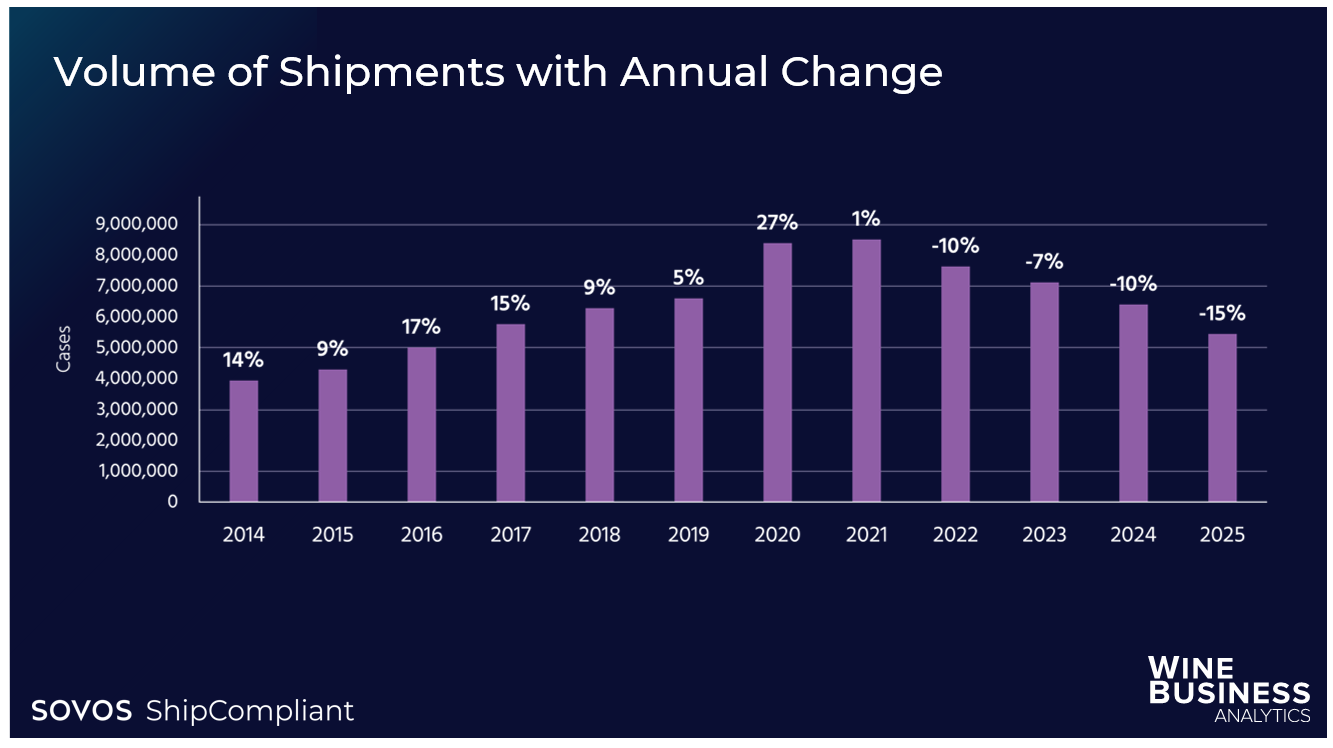
The DtC wine market has gotten harder. According to the Sovos ShipCompliant Direct-to-Consumer Wine Shipping Report, wineries are operating in a more pressured market with tighter demand, changing consumer behavior, and more competition for each order.
In that environment, finding new members is harder and more expensive. That makes the members you already have worth more attention than most wineries give them.
Why Retaining Wine Club Members Is More Profitable Than Replacing Them
Wine club revenue is a product of three things: number of members, average shipment value, and purchase frequency. When any one of those slips, revenue goes with it. When two slip at the same time, the impact compounds quickly.
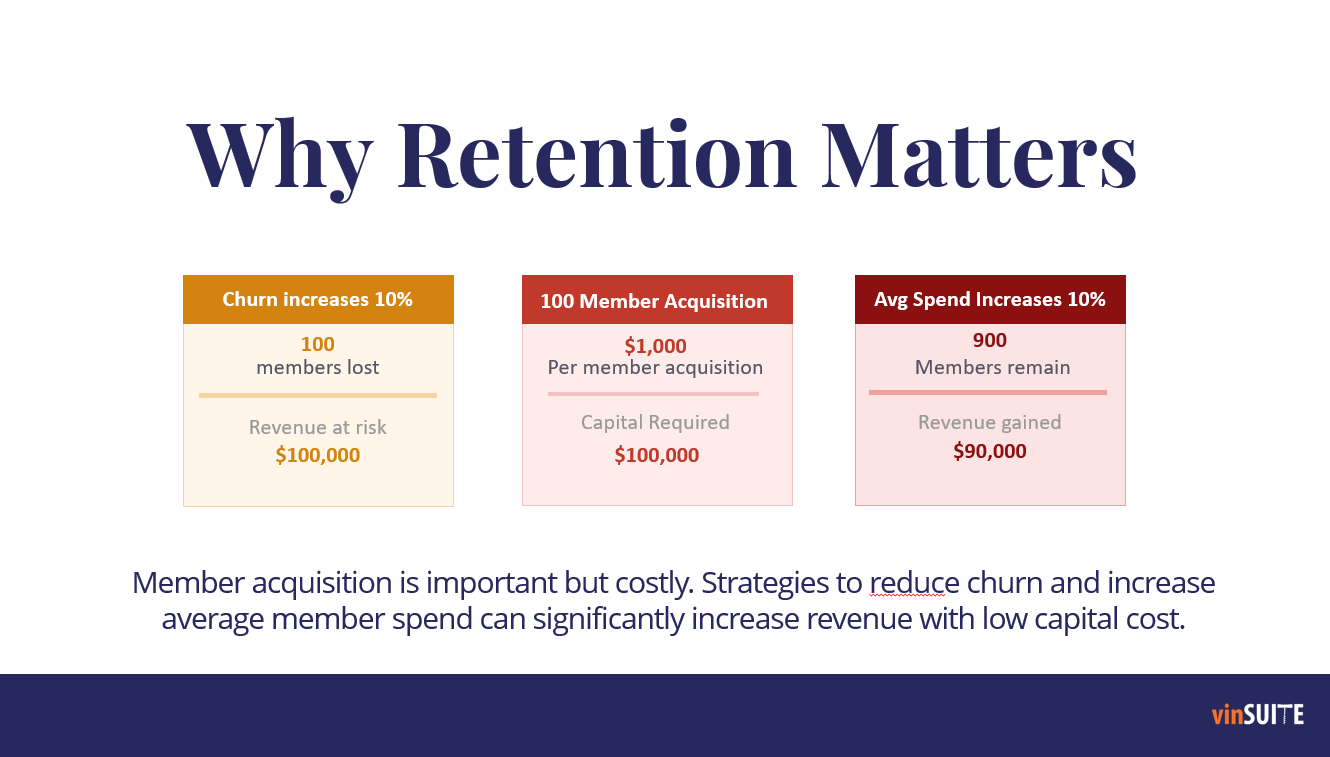
A club with 1,000 members spending $1,000 per year generates $1 million in revenue. If churn rises by 10%, $100,000 in recurring revenue is at risk. Replacing those 100 members through acquisition can take significant time, budget, and staff attention just to get back to where the club started.
Acquisition still matters. But for many wineries, there is often more immediate revenue opportunity inside the current club than outside it. That is why wine club retention should be treated as a revenue lever, not just damage control.
Why Cancellation Reports Do Not Prevent Wine Club Churn
Most wineries have access to reporting. They can see cancellations, skipped shipments, failed cards, and other hard outcomes. The problem is that many of those reports are lagging indicators. By the time a member shows up on a cancellation report, the relationship has already changed.
Every row in a cancellation report represents a member you no longer have. The data is still useful, but it does not give your team much room to act.
If your retention process only starts when someone cancels, you are not really managing retention. You are documenting loss.
What Are the Early Signs of Wine Club Churn?
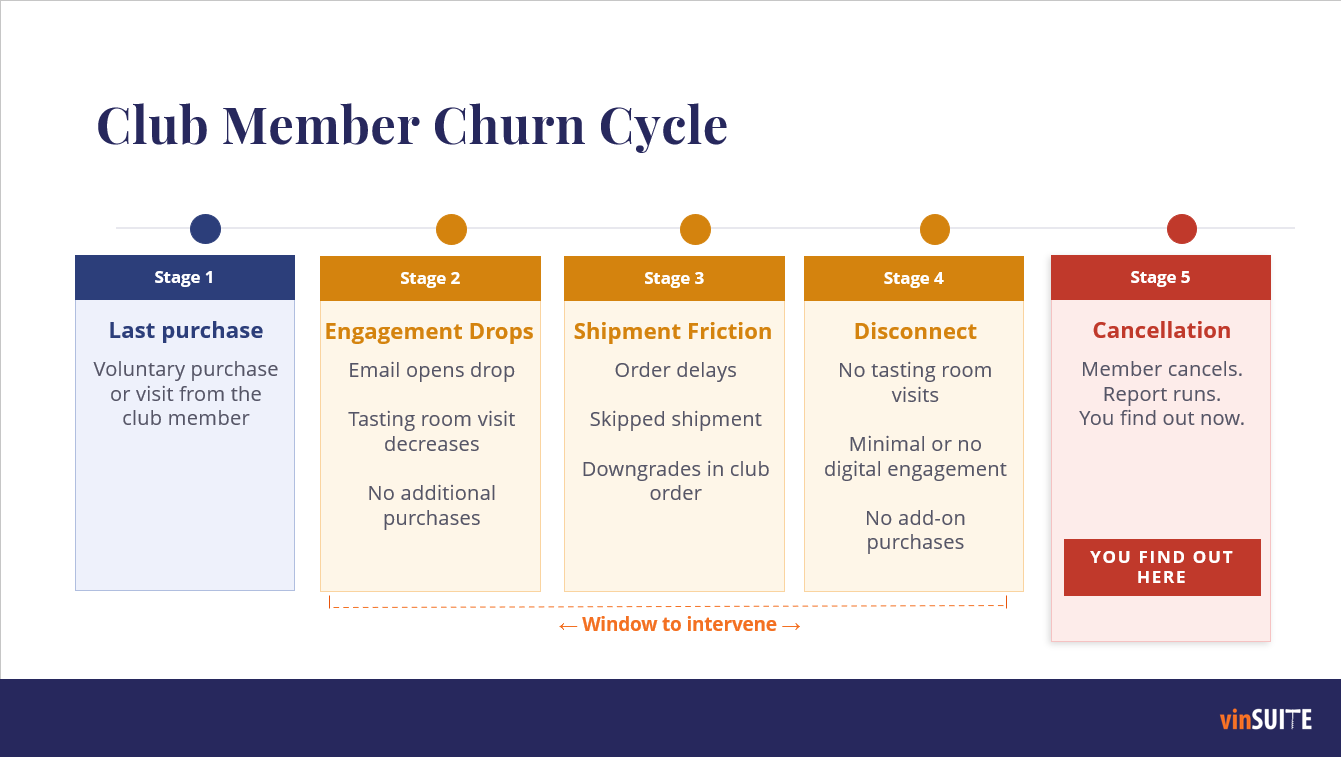
Churn is rarely a sudden event. It usually follows a progression, and most members leave clues along the way.
| Stage | What Is Happening |
|---|---|
| 1. Last meaningful purchase or visit | The relationship is still active, but momentum quietly stalls. |
| 2. Engagement drops | Email opens and clicks decline. Tasting room visits slow down. The member is still on your list but has stopped paying attention. |
| 3. Shipment friction starts | Skipped orders, shipment delays, downgrades, or failed payments create distance between the member and the club. |
| 4. Disconnect | No tasting room visits. Minimal digital engagement. No add-on purchases. The relationship has gone quiet. |
| 5. Cancellation | You find out here, but the drift started much earlier. |
Between stage one and stage five, there is a window to intervene. For most members, that window may be weeks or months wide. The question is whether your team has visibility into what is happening during that time.
How Can Wineries Predict Wine Club Churn?
Traditional reports track hard outcomes: cancellations, shipment skips, failed payments, and other visible events. Those are worth watching, but they often confirm churn after the risk has already become obvious.
Churn prediction looks at earlier signals. These may include reduced email engagement, declining purchase frequency, smaller order values, fewer tasting room visits, fewer add-on purchases, or a change in club behavior.
The goal is to shift from reacting to anticipating. Not because the data is perfect, but because acting earlier gives your team more options than acting later.
Want Better Visibility Into At-Risk Members?
vinSIGHT helps wineries identify churn risk, revenue at risk, and member segments directly inside the vinSUITE admin panel.
What Is RFM Analysis for Wine Clubs?
RFM is a segmentation model built around three measures: recency, frequency, and monetary value. It is not a new idea, but it is underused in wine club management, and it gives wineries a more useful picture of their members than a simple active or canceled view.
| Dimension | What It Measures | Why It Matters |
|---|---|---|
| Recency | How recently did they purchase, visit, or engage? | Long gaps are often one of the first signs a member is pulling back. |
| Frequency | How often do they show up across touchpoints? | Regular engagement often signals a stronger and more durable relationship. |
| Monetary | What has this member actually spent? | Knowing where value is concentrated helps your team decide where to focus retention efforts. |
Scored together, these three dimensions turn your member list into something more useful: a picture of who is engaged, who is slipping, and who needs attention soon. This is where connected wine club software, winery CRM, and winery analytics can make retention work more practical.
How Member Segmentation Improves Retention Campaigns
The point of RFM is not just to score members. It is to group them in a way that shapes what your team does next.
A new member needs a different experience than a long-tenured member who has gone quiet. A high-value member who is disengaging deserves a different response than someone who just joined and has not yet bought anything beyond their first shipment.
Generic outreach tends to underperform because it treats every member the same. A re-engagement email sent to a brand-new member does not make sense. A welcome series sent to someone who has been a member for six years does not either. Segmentation lets you match the message to where the member actually is.
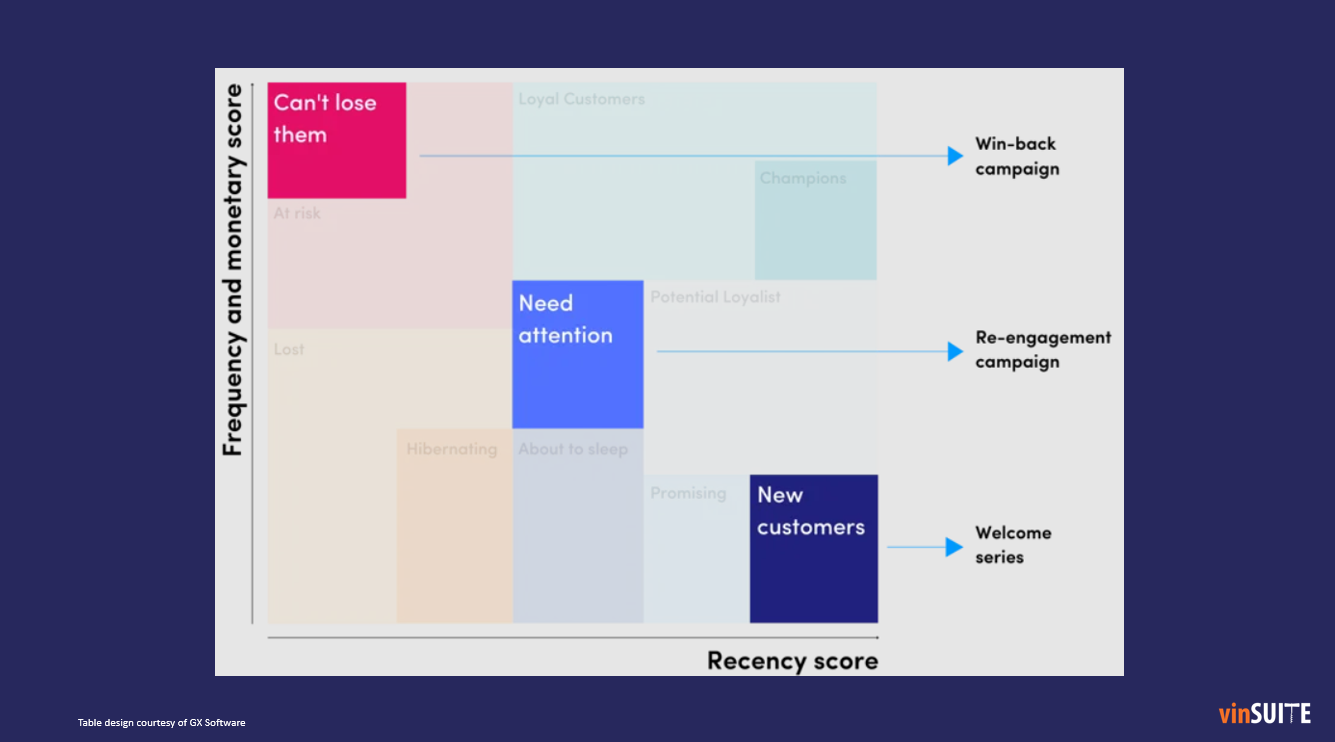
| RFM Segment | Recommended Campaign Type |
|---|---|
| New customers or new members | Welcome series, education, first-purchase follow-up, and club benefit reminders |
| Members needing attention | Re-engagement campaign, personalized check-in, or targeted shipment reminder |
| High-value lapsed members | Win-back campaign, concierge outreach, special invitation, or manager follow-up |
| Champions and loyal members | VIP recognition, exclusives, referral opportunities, and early access offers |
How to Reduce Wine Club Churn: 4 Practical Steps
1. Track more than cancellations
Behavioral signals like email engagement, visit history, add-on purchases, shipment skips, and changes in order value give you earlier visibility into who is drifting. Start collecting and reviewing those signals if you are not already.
2. Score members by RFM
You do not need a complicated model to get value from this. Even a basic segmentation of your club by recency, frequency, and spend can surface patterns that are easy to miss in a standard member list.
3. Match outreach to the segment
Build different communication flows for new members, engaged members, disengaging members, and lapsed members. The right message at the right time can do more than the same message sent to everyone.
4. Act before the window closes
The best time to reach a member is well before they cancel. The further along the churn cycle someone gets, the harder it is to bring them back.
Wine club churn starts long before cancellation. That means retention work has to start earlier too, not as a one-time campaign but as an ongoing part of how you manage the club.
Wineries that build that habit are better positioned to protect recurring revenue, strengthen member relationships, and make smarter decisions about where to focus their team’s time. For more on the metrics behind retention, visit our guide to wine club metrics.
Where vinSUITE Fits
Reducing churn is harder when your wine club, tasting room, ecommerce store, CRM, and reporting all live in disconnected places. Your team may have the data, but still struggle to turn it into action.
vinSUITE brings core winery DtC tools together in one connected platform, including wine club management, tasting room POS, ecommerce, CRM, and vinSIGHT analytics.
vinSIGHT helps wineries see predictive churn scoring, RFM analysis, and member segments directly in the admin panel, so teams can focus on the members who need attention before it is too late.
Frequently Asked Questions
What is wine club churn?
Wine club churn is the percentage of members who cancel their membership over a given period. Reducing churn helps wineries protect recurring revenue and reduce the cost of replacing lost members.
What are the earliest signs a wine club member may cancel?
Common warning signs include declining email engagement, fewer tasting room visits, skipped shipments, reduced purchasing, smaller order values, and longer gaps between interactions.
What is RFM analysis?
RFM stands for recency, frequency, and monetary value. It helps wineries group members based on how recently they engaged, how often they interact, and how much they spend.
How can wineries reduce wine club churn?
Wineries can reduce churn by identifying at-risk members early, segmenting members by behavior and value, and sending timely outreach before cancellation happens.
Can vinSUITE identify members at risk of cancelling?
Yes. vinSIGHT includes predictive churn scoring and RFM analysis to help wineries identify members showing signs of disengagement, so teams can take action earlier.
Why does connected winery DTC software matter for retention?
Connected winery DTC software helps teams see club activity, ecommerce orders, tasting room behavior, CRM data, and analytics in one place, making it easier to spot risk and follow up with the right members.
See Which Members Need Attention Before They Cancel
The best retention strategies start before cancellation happens. See how vinSUITE brings your wine club, CRM, ecommerce, tasting room, and vinSIGHT analytics together so your team can identify at-risk members and strengthen member relationships from one connected platform.